

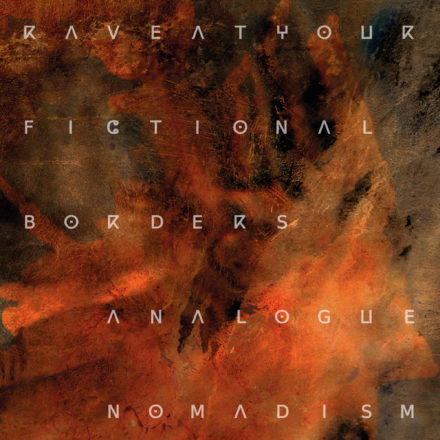
Rave At Your Fictional Borders
-Analogue Nomadism
Salim Akki - drums & vocals
Marius Mathiszik - guitar, loops & sampler
Dave De Rose - electric bass & fx
All music composed and performed by Salim, Marius & Dave 22-29 September 2024
Recorded and composed live at the "L'Bridge"
Recording studio in Kenitra, Morocco
Engineered by Selim El Bousaidi & Jamal Essouri
Mixed and co-produced by Dan Nicholls
Artwork by Panos Baras
It is neither night nor day, but there is a half-light all the time. What used to be disconcerting is now not alien anymore. The sky boasts a faint light. Certain shapes are laid out, but get changed through communal ritual. Analogue Nomadism is the music of a feeling of community. It builds and breaks down. It is accepting of the psychedelic standards of the groove. Transportative and vertiginous. Endless.
reviews
Moin, Charles Hayward, Shackleton, Holy Tongue. or Giulio Erasmus fiends need a taste of this rudely elegant take on experimental rock styles, with clear similarities in the taut, jabbing drums, wiry guitars and angular, dubbed electronics recorded by a trio in Morocco.
An international three-piece made up of London-based Moroccan drummer Salim Akki, Athens-based German experimental composer Marius Mathiszik and Anglo-Italian multi-instrumentalist and producer Dave De Rose, who lives between Rome, London and Athens, Rave at Your Fictional Borders is “not beyond borders,” they explain, they “simply deny any notion thereof.” Their debut album was recorded in Morocco and is as open-ended as their concept, a blend of grooves, musical forms and tonalities that attempts to capture the physicality of the rave without reproducing any of its identifying elements. So a track like ‘Warblers’ might have you thinking of Italian library music at one moment before it spirals into psychedelic jazz or ritualistic desert blues, and opener ‘Spoonbill’ sounds like Chicago post-rock at first before De Rose’s bass takes hold, dueling with Akki’s vocals and Mathiszik’s fizzed twangs.
You can trace their influences, but it remains difficult throughout to place the music itself. The fusion, if it’s even correct to call it that, feels genuinely holistic, created through shared interests and an omnivorous, open-minded ear for sonics rather than an attempt to follow the well-trodden path. Like the best krautrock or gnawa music, ‘Analogue Nomadism’ is an album that lives and dies on the strength of the groove.
https://boomkat.com/
Since finding the final third piece of their trio last year with the inclusion of Moroccan drummer and singer Salim Akki, Rave At Your Fictional Borders have moved at quite a pace to realise (and release) their first full album ‘Analogue Nomadism’. As always, spontaneity is at the root of their improvised grooves. Their self-titled ‘Global Experimental Music’ was created and recorded over a week in the L’Bridge studio outside Kenitra in Morocco, the resulting album a sprawling collage of trippy textural strangeness and rhythmic explorations that punch and intrigue in equal measures.
All of the album’s song titles are named after migratory birds and as the album title also suggests, this multinational outfit cares little for this currently divisive world we inhabit. “We are very tired with the stuffy concept of the world being divided by artificially drawn state borders,” says Marius Mathiszik, the band’s German guitarist and FX wizard. “While we can’t change the big political stage, we want to spread positivity. Our deep belief is that if people meet in a truly open and empathetic way, these concepts are not only intellectually obsolete but frankly against nature.”
With tracks that appear to channel ‘Live Evil’ era Miles Davis, CAN, the weirder, post-punkier end of On-U Sound, a touch of the deconstructed Angolan dance music of Principe Records, and North African influences courtesy of Salim, the album has been given a killer mix from Dan Nicholls, an acclaimed improviser and untethered musician himself. Without losing the free movement of the trio’s spontaneous creativity, he has given the record a tough contemporary anchor, the bass and drums hit hard, the freakout textures and dub fix signals given a clear and active presence in the mix. It sounds great.
Not ‘songs’ in the traditional sense, each track nevertheless has a (psychedelic) identity of its own. The opening number ‘Spoonbill’ was composed and recorded on the fly (the moment captured in the video below), its narcotic, woozy groove an egoless dance of sludgy dub space, hazy backwards masking and unshowy simplicity. Marius’ looping guitar feedback gives it a textural scrape before Salim glides his voice through the ether, the surrounding desertscape never far away.
‘Limosa’ howls into existence with windy, haunting feedback before a disjointed Afro-dub rhythm joins the frayed atmosphere. Scorched guitar waves and Dave de Rose’s minimalist bass throb that focuses the centrepoint allow the drums to break right down. This is an odd bird.
Staying in the broken dub galaxy, ‘Falco’ starts like a shattered Shaka tune before hitting a gnarly, ravey second half, Dave’s picked bass filtering nastily, the drums double-timing, Marius’ guitar adding all kinds of aggressive sandpaper and micro-melodies.
Warblers are small, fast moving birds with pretty songs. The next track ‘Warblers’ is none of those things. Tense, slow and monotonous, this dread-laden groove creeps along with murder in its heart. A prodding one-note bassline pummels away to a halftime beat and layers of spooked out noises made by god-knows-what. Like an old jungle tune played at the wrong speed, it’s wrong but it’s also right.
Not a million miles away from CAN rhythm maestro Jaki Liebezeit’s experiments with Burnt Friedman, ‘Spatula’ sounds like Nigerian Afrobeat rinsed through a washing machine. Backwards and forwards picked guitars slide beautifully inside Salim’s exquisite drum pattern, whilst a squelchy synth bass gathers weight ending in a serious electronic punch towards the end. Salim’s trippy vocal is the extra magic on perhaps the most focussed song on the album.
The longest and funkiest track on the record, ‘Shrike’ sees Salim really letting rip with his voice over some killer bass action from Dave. As someone used to hearing the Gnawa tradition of call-and-response, I’m loving hearing Salim’s Moroccan tones singing in a different way. Nicknamed ‘the butcher bird’, shrikes, despite being relatively small song birds, are known for impaling mice and insects on thorns and barbed wire to eat later, a shocking contrast to their outward appearance. Knowing the band’s political thoughts on the casual cruelties of powerful men and organisations, I’m guessing they knew what they were doing when they named this track because its insistent angular funk carries a sting.
‘Calliope’ winds the album down with a starkly direct vocal from Salim over a swirling circular groove of laidback drums, FX, psychedelic guitars and a deep bassline evoking late night jam sessions and smoky festival stages from the 70s onwards. Pungent, atmospheric and dazed, its trancey physicality eventually whispers away into the ether.
Rave At Your Fictional Borders is undoubtedly a band now. Existing somewhere outside of themselves, the three make the one and the sound is brave, exploratory and kind of strange. ‘Analogue Nomadism’ feels like a moment where everything clicked and I expect them to click again in the not so distant future. 9/10.
Words by Justin Turford (truth and lies)
www.truthandliesmusic.com